GEORGE
BYRON
NATIONAL CENTER
George (Lord) Byron Monument. Memorial in Yerevan, Armenia.

- About GEORGE BYRON -
George Gordon Byron, 6th Baron Byron FRS (22 January 1788 – 19 April 1824), was an English Romantic poet and peer. He was one of the leading figures of the Romantic movement and is regarded as one of the greatest English poets. Among his best-known works are the lengthy narratives "Don Juan" and "Childe Harold's Pilgrimage", and many of his shorter lyrics in "Hebrew Melodies" also gained popularity.
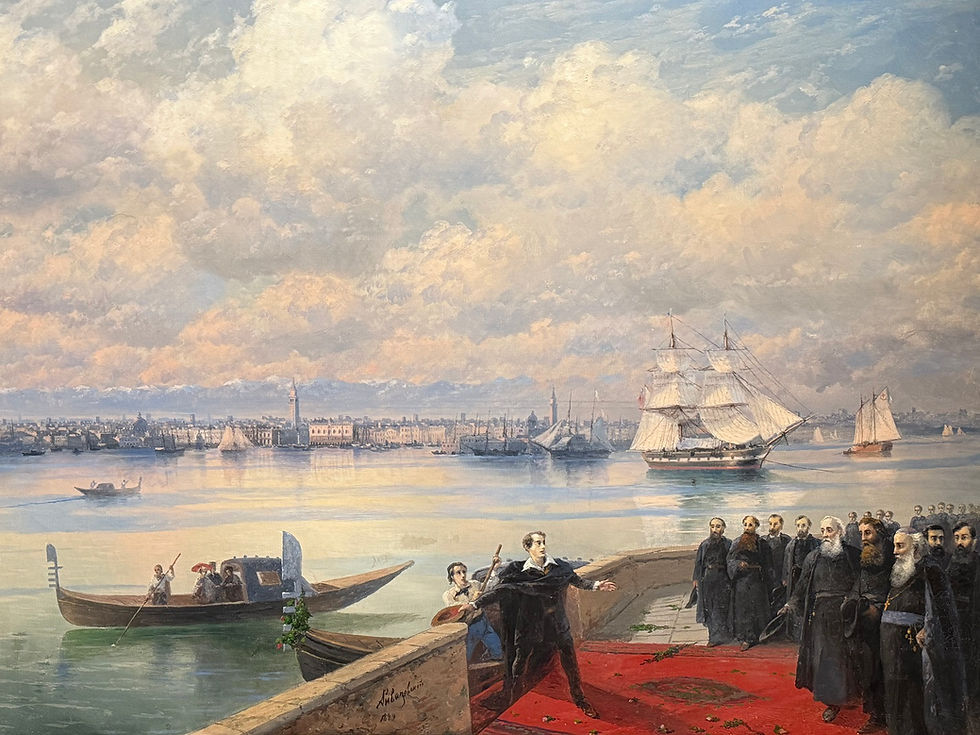
Lord Byron was educated at Trinity College, Cambridge, and later traveled extensively across Europe, including several years in Italy. While in Venice, he lived on the island of St. Lazarus in the Armenian monastery. During his time in Italy, he frequently visited his friend and fellow poet Percy Bysshe Shelley. In the latter part of his life, Byron joined the Greek War of Independence, fighting against the Ottoman Empire. He eventually died while leading a campaign during that war and is revered by Greeks as a folk hero. Byron passed away in 1824 at the age of 36 from a fever contracted after the sieges of Missolonghi.

English romantic poet and peer
George Gordon Byron, 6th Baron Byron FRS (22 January 1788 – 19 April 1824) was an English romantic poet and peer. He was one of the leading figures of the Romantic movement, and has been regarded as among the greatest of English poets. Among his best-known works are the lengthy narratives Don Juan and Childe Harold's Pilgrimage; many of his shorter lyrics in Hebrew Melodies also became popular.
Lord Byron was educated at Trinity College, Cambridge, later travelling extensively across Europe to places such as Italy, where he lived for seven years in Venice, Ravenna, and Pisa after he was forced to flee England due to lynching threats. During his stay in Italy, he frequently visited his friend and fellow poet Percy Bysshe Shelley.
In 1816, Byron visited San Lazzaro degli Armeni in Venice, where he acquainted himself with Armenian culture with the help of the monks belonging to the Mechitarist Order. With the help of Father Pascal Aucher (Harutiun Avkerian), he learned the Armenian language and attended many seminars about language and history. He co-authored Grammar English and Armenian in 1817, an English textbook written by Aucher and corrected by Byron, and A Grammar Armenian and English in 1819, a project he initiated of a grammar of Classical Armenian for English speakers, where he included quotations from classical and modern Armenian.
Byron later helped to compile the English Armenian Dictionary (Barraran angleren yev hayeren, 1821) and wrote the preface, in which he explained Armenian oppression by the Turkish pashas and the Persian satraps and the Armenian struggle of liberation. His two main translations are the Epistle of Paul to the Corinthians, two chapters of Movses Khorenatsi's History of Armenia, and sections of Nerses of Lambron's Orations.
His fascination was so great that he even considered a replacement of the Cain story of the Bible with that of the legend of the Armenian patriarch Haik. He may be credited with the birth of Armenology and its propagation. His profound lyricism and ideological courage have inspired many Armenian poets, the likes of Ghevond Alishan, Smbat Shahaziz, Hovhannes Tumanyan, Ruben Vorberian, and others.
Later in life Byron joined the Greek War of Independence fighting the Ottoman Empire and died leading a campaign during that war, for which Greeks revere him as a folk hero. He died in 1824 at the age of 36 from a fever contracted after the first and second sieges of Missolonghi.
Monument of George Byron
Today, Armenia actively participates in international processes and has chosen the path of sustainable democracy while seeking deeper integration with its sister countries in Europe and European institutions. Armenia is part of European civilization, rooted in its Christian heritage. Historically, Armenia and the United Kingdom share a deep connection and have mutually influenced each other positively. Through this project, we aim to commemorate this bond by honoring George Byron.
In addition to the historical ties between Armenia and the United Kingdom, the two countries have maintained friendly relations throughout history. The reconstruction of the English Park in Yerevan, along with the installation of a monument to George Byron, will serve as a significant occasion to strengthen bilateral relations and reinforce our historically close ties.
English Park in Yerevan, Armenia
In the heart of Yerevan, there is an English park that holds significant potential for development and the creation of a vibrant cultural and entertainment environment.
Installing a monument to George Byron in the center of the English Park would be a fitting tribute, symbolizing the friendship between Armenia and Britain.